

Deep Dive: Archi-Type 1™ — The Early-Experience Starter
Part 1 of 4 in the SMB Marketing Archi-Types™ series. Next up: Archi-Type 2™ — Structure, Consistency & Channel-Addition, followed by Archi-Type 3 and Archi-Type 4.
Before We Begin: A Quick Note on Tools, Costs, and the Reality of SMB Marketing
For many SMB owners, marketing feels like one giant guessing game. And while “channels” deserve their own discussion, the real frustration usually begins long before that — in the tools themselves.
The landscape is packed with subscription-based marketing platforms promising simplicity, automation, and growth. But the moment you start adding features (segmentation, scoring, testing, workflows) or sending more emails, costs begin to rise — sometimes sharply.
It’s an inverted value curve:
The better you try to market your business, the more subscription platforms charge you for it.
Most early-stage SMBs unintentionally get caught in this trap, paying for functionality they aren’t ready for yet — or worse, functionality they don’t actually need in Archi-Type 1™.
That’s why the tools discussion must come first.
Invest in your business — not another platform’s pricing tiers.
Why BettaWerks™ Is Different
We built BettaWerks™ with a different philosophy:
- One-time purchase
- Lifetime ownership
- Standard hosting (~$50/month)
- Up to 50,000 emails/month included
- No forced upgrades, no usage-penalties
Beginners should be able to build a correct 30, 60, and 90-day foundation without being punished for sending more or learning faster.
SMBs deserve freedom to grow — not hidden costs.
Don’t you deserve Betta?
The Heart of This Guide
This deep-dive article is your companion to the new SMB Marketing Archi-Types™ Framework, an original, research-based maturity model from QuixTec, LLC.
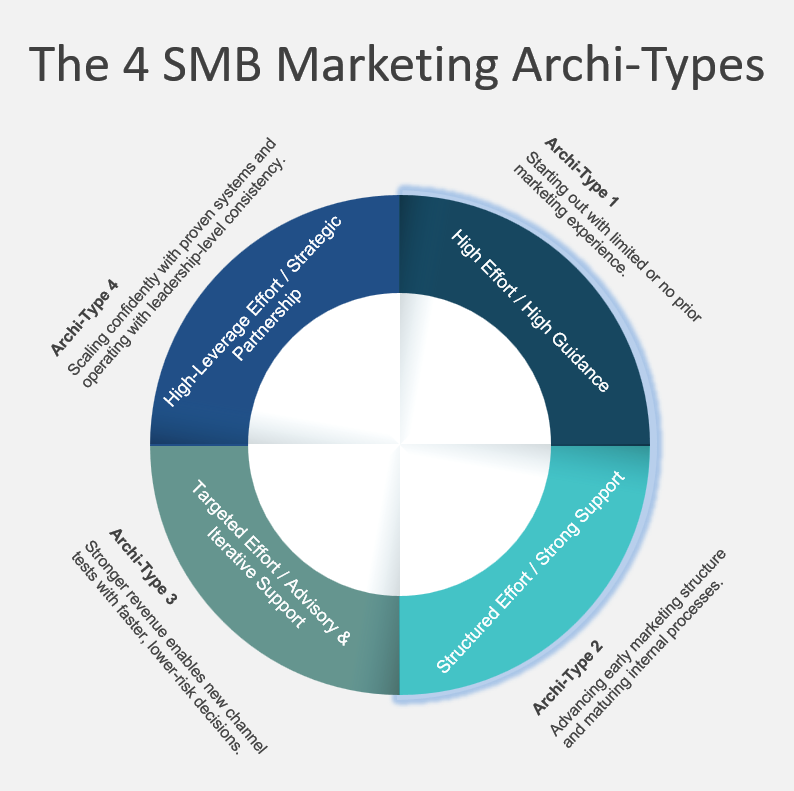
Each Archi-Type™ represents a stage of marketing readiness — not a ranking, not a hierarchy, not a judgment:
- It simply tells you where your business is today
- What you’re ready for
- What you shouldn’t invest in yet
- And how to move confidently into the next phase
And if you’re in Archi-Type 1™, you’re not “behind.” You’re simply starting, which is where every strong marketing foundation begins.
Why it often feels hard: One reason small businesses feel stretched thin is that their marketing strategy doesn’t match their current stage of growth — pulling them in too many directions and making everything harder than it should be. Archi-Types™ exists to help you avoid that mismatch and choose a path that fits where you are today, so progress becomes clear and sustainable.
Who This Guide Is For
If any of the following sounds familiar, you’re in the right place:
- You’ve never formally done “marketing” before
- You don’t have a persona or clean contact list
- You’re unsure what to say or who exactly to target
- You have little time and even less clarity
- You want a simple, guided place to start
- You need someone to show you the steps — not sell you complexity
This guide will walk you through the first 90 days of effective, realistic, SMB-friendly marketing — built on structure, learning loops, and clarity, not chaos or guesswork.
A Final Note Before We Dive In
Marketing maturity isn’t a straight line. Businesses don’t magically “jump” from one stage to the next. They transition:
- Part of your system might be acting like Archi-Type 1™
- Other parts might be creeping into Archi-Type 2™
- Some decisions might feel Archi-Type 3™
- And your ambition might already be Archi-Type 4™
That’s normal. Archi-Types™ ™ simply give you context, direction, and confidence.
What’s an Archi-Type™?
A term you won’t find anywhere else — because we invented it.
An Archi-Type™ is a foundational blueprint that describes where your business truly is in its marketing development. Not where you wish you were, not where a SaaS platform tells you to be, and definitely not where your inbox full of marketing “gurus” insists you should be.
This is reality. Your reality.
Marketing maturity has structure — and once you understand that structure, everything becomes clearer:
- What you’re ready for
- What you’re not ready for (yet)
- What makes sense to invest in
- What to avoid like the plague (or like a “free trial” with a renewal timer)
- What foundation you need next
The Meaning Behind the Name
Archi → from the Greek archē: origin, foundation, governing principle Type → a category, pattern, or model that reflects your current level
Put together:
Archi-Type™ = A specific stage of your marketing architecture.
(Yes — the hyphen is intentional. No, we’re not negotiating that. The English-language police can call our office line if they disagree.)
Why Archi-Types™ Matter
Most SMB marketing problems aren’t caused by bad ideas. They’re caused by bad timing.
Using the wrong tool at the wrong stage… Trying the wrong strategy for your maturity level… Jumping into “tactics” before having a foundation… Or the classic:
Attempting Archi-Type 3™ or Archi-Type 4 activities while still in Archi-Type 1.
That’s how budgets evaporate and confidence drops.
Archi-Types™ exist to — politely — stop you from doing that.
What Your Archi-Type™ Determines
Your current Archi-Type™ gives you clarity on:
- Your best-fit marketing strategy
- Your realistic budget
- Your effort level
- Your pace of growth
- Your ideal channels (later)
- The type of guidance you need
- What to ignore entirely
- And how to move confidently into the next stage
In other words: It tells you where you are today so you can stop guessing about tomorrow.
A Model Built on Equality, Not Hierarchy
Archi-Types™ aren’t ladders. They’re not rankings. They’re not “beginner vs. advanced.”
They’re equal stages within a circular system — because marketing isn’t linear, and SMBs don’t grow in neat, straight lines. Every Type is valid, every Type has its purpose, and every Type comes with its own benefits and challenges.
And if you’ve ever felt like your marketing is “all over the place,” that’s normal:
- One part of your system might be acting like Archi-Type 1™
- Another part might be drifting into Archi-Type 2™
- Some decisions may already look like Archi-Type 3™
- And your ambition might be Archi-Type 4™
This isn’t inconsistency. This is growth.
The Transition Zone (You’re Probably In One Right Now)
Businesses rarely move between stages cleanly. Instead, they spend real time in the transition zone — a space where some elements are maturing while others lag behind.
We visually capture this in the Archi-Types™ wheel with a highlighted arc that shows normal, healthy progression.
No shame. No pressure. Just clarity.
Bottom Line: Why This Matters to SMBs
Your Archi-Type™ helps you:
- Stop chasing random tactics
- Stop copying what you see on LinkedIn, YouTube and other social platforms.
- Stop wasting budget on tools and “latest trends” you don’t need
- Understand your stage and your path
- Use marketing that adapts quickly, so you’re never stuck with yesterday’s plan.
- Grow at a pace that fits your business
- Make decisions based on readiness, not fear or guesswork
And yes… It might even help you sleep better at night.
(We’re not promising that, but if it happens, we’ll take the win.)
Onward to Archi-Type 1™…
Now that you know what Archi-Types™ are, it’s time to enter the deep dive for Archi-Type 1™ — The Early-Experience Starter.
Grab a coffee. Buckle in. And let’s build your foundation.
Archi-Type 1™ — The Early-Experience Starter
Where marketing begins — not where businesses fail.
If you’re in Archi-Type 1™, you’re not behind. You’re not late. You’re not doing it wrong.
You’re simply at the starting point, the same place thousands of SMBs begin their marketing journey long before anything “clicks.”
Every business enters this phase. Only the honest ones admit it.
What Archi-Type 1™ Really Means
Archi-Type 1™ describes businesses that have:
- Little to no marketing experience
- Not yet defined their ideal customer
- No clean, targeted contact list
- Few (or zero) reusable campaign assets
- No CRM structure or inconsistent usage
- Limited time, limited clarity, and limited budget
- A high need for guidance, direction, and simplicity
In other words:
You don’t need complexity — you need clarity, confidence, and a starting point that actually works.
This is the “foundations” phase. Not glamorous, not flashy — but absolutely essential.
The Real SMB Struggle: A Marketing Maze With No Map
For years, SMBs have been wandering through a marketing maze with no map, no markers, and no real direction. “Marketing advice” tends to come from whoever shows up at the right moment — often a salesperson with a quota, not someone aligned with what your business is truly ready for.
And that’s where things go sideways.
SMBs end up making decisions based on persuasion, pressure, or the promise of “quick wins,” instead of their actual marketing maturity — their Archi-Type™.
It’s expensive. It’s discouraging. And it’s completely avoidable.
Archi-Types™ change that.
It gives SMBs a practical, grounded framework they can follow from day one — a clear sense of where they are, what they should be doing, and what they can safely ignore.
No guessing. No guru-hopping. No shiny-object detours.
Just confident, guided progress.
Why Archi-Type 1™ Is So Important (and so misunderstood)
Most early-stage SMBs skip straight to Archi-Type 3™ or Archi-Type 4 tactics because they look exciting:
- Funnels
- Workflows
- Personalization engines
- Multi-channel automation
- Data dashboards
- A/B tests inside segmentation inside workflows inside… oh no
This is how people end up paying a premium for tools designed for businesses three levels ahead of them.
Archi-Type 1™ protects you from that.
It pulls you away from noise, burnout, and tool-shopping… and into a focused, realistic path with:
- a clear audience,
- a clear message,
- a clear list,
- a clear first campaign,
- and a clear weekly rhythm.
That’s the backbone of sustainable marketing.
The Archi-Type 1™ Mindset (You’re Going to Like This)
Archi-Type 1™ isn’t about perfection. It isn’t about brilliance. It isn’t about speed.
It’s about starting well.
You’re not here to build a marketing empire overnight. You’re here to:
- set the foundation,
- test the basics,
- learn from early signals,
- and build confidence without burning out.
If this resonates, good news — you’re exactly where you should be.
And no, you don’t lose Founder Points for admitting you’re in Archi-Type 1™.
In fact, it’s the smartest move you can make.
Where Archi-Type 1™ Leads You Next
Once your basic structure is in place — persona > list > message > first campaign > follow-up rhythm — you naturally begin to outgrow Archi-Type 1™ and slip into:
Archi-Type 2™ — where structure, confidence, and early consistency take shape.
And that’s where momentum really begins.
But first… we’re going to turn Archi-Type 1™ into your strongest possible foundation.
(Spoiler: You’re closer than you think.)
Staff ≠ Stage
Even if a Startup has funding and hires a marketer or salespeople, that does not automatically move them beyond Archi automatically move them beyond Archi-Type 1.
Marketing maturity is determined by readiness, not headcount.
Before any team can succeed, the business must still build:
- A clear persona
- A validated contact list
- A simple, human
- A first executable campaign
- A basic CRM foundation
- A weekly follow-up rhythm
- Only after these exist does staff accelerate progress — they do not replace the work of Type 1.
Bottom line: You can hire staff for execution, but you cannot hire staff to skip a stage
What Archi-Type1™ Businesses Typically Look Like
Not every early-experience business looks the same, but most share a familiar pattern. If any of these describe your current situation, you’re exactly where countless successful SMBs started:
Common Characteristics of an Early-Experience Starter
Marketing is either brand new or lightly attempted (Maybe a couple of emails, a random post, or an old campaign attempted once and abandoned.)
No clearly defined audience or ideal customer profile You know who you could help — but not who you should target first.
A small, outdated, or unvalidated contact list Contacts may live in spreadsheets, inboxes, or memories.
Messaging that doesn’t resonate yet It might sound “salesy,” unclear, generic, or too product-focused.
No CRM, or one that was installed and never fully adopted This is extremely common — more common than anyone admits.
Limited time and bandwidth Marketing competes with operations, sales, customer service, and “everything else.”
Inconsistent activity You start, stop, try again, stop again — because without direction, it’s exhausting.
A high need for guidance and clarity Not all SMB owners are natural marketers — and they shouldn’t have to be.
A Reality Most SMBs Experience (But Rarely Talk About)
SMBs know they need to market. They try. But when that first email doesn’t get replies… they often assume:
- “This doesn’t work.”
- “I must be bad at marketing.”
- “People aren’t interested.”
- “Email isn’t for my industry.”
- “I’m bothering people.”
In reality?
It was just one message — not the entire truth.
The lack of response could have been caused by:
- Unclear messaging
- Sounding too “salesy”
- Targeting the wrong people
- Missing their pain point
- Weak subject lines
- Poor timing
- Discoverability issues
- Not following CAN-SPAM rules
- A mismatched offer
- Or simply… normal first-send behavior
Most SMBs don’t analyze what worked or what didn’t — they simply give up too early, which is tragic because improvement only comes from:
- Redirecting
- Refining
- Re-sending
- Learning
- Adapting
- And trying again
With support and guidance, that first failed message becomes:
- A data point
- A signal
- A learning opportunity
- And NOT a reason to quit
This is exactly why Archi-Type 1™ businesses benefit from hands-on guidance. Nobody should have to navigate early-stage marketing alone.
What This Means (And What It Doesn’t Mean)
Being in Archi-Type 1™ does not mean:
- You’re behind
- You’re late
- You’re failing
- You lack potential
- You “should” be further along
- Or you’ll “never get it”
It simply means you’re in the early-experience phase, where clarity, structure, and foundational wins matter more than tools, tactics, or complexity.
And honestly?
You’re in the most important phase of all — the one where your future wins are built.
The Challenges Early-Experience (Type 1) Businesses Face
Marketing isn’t hard because SMBs lack intelligence or drive. Early-experience businesses run into obstacles that no platform, no guru, and no “10-step funnel hack” explains clearly.
Here are the most common challenges—if any of them hit home, you’re in the right place.
1) Overwhelm from Too Many “Options”
Email. Social. Ads. Funnels. Webinars. A/B tests. And that’s before you even pick a tool. Archi-Type 1™ teams often try to start everywhere at once—and end up paralyzed. Without guidance, “options” quickly become noise.
2) Tools Designed for Later Stages
Most SaaS platforms assume you already have:
- A list
- A clear message
- Defined segments
- A known buyer
- Active campaigns
Archi-Type 1™ founders install the tool… then stare at empty dashboards wondering what they’re missing. Answer: nothing—the tools were simply built for the wrong stage.
3) The First Campaign Fails—and Confidence Drops
This one breaks our hearts every time.
SMBs know they need to market. They try. Then that first email gets:
- Nno replies
- No clicks
- No momentum
- And the assumptions kick in:
- “Email doesn’t work for my industry.”
- “I’m annoying people.”
- “Marketing is too complicated.”
- “I’m just not good at this.”
- “I don’t have time for this.”
In reality? It was one message. One test. One data point. That’s not failure — it’s the starting signal.
4) The Hard Truth: The Marketing Industry Isn’t Built for Early-Experience SMBs
There’s another challenge Archi-Type 1™ (and even Archi-Type 2) businesses face—and it’s rarely discussed openly:
The marketing services industry is heavily weighted toward Archi-Type 3™ and Archi-Type 4 SMBs. It’s not malicious. It’s math.
Archi-Type 3™ and Archi-Type 4 businesses:
- Have bigger budgets
- Have consistent revenue
- Require less hand-holding
- Are easier to onboard
- Can afford long-term retainers
So, agencies naturally gravitate toward them. (It’s hard to blame them — they have payroll, too.)
But the downside is brutal: Early-experience SMBs are left with fewer real-world resources, less support, and almost nobody willing to guide them through the fundamentals.
So, Archi-Type 1™ and Archi-Type 2 founders try to piece together their marketing from:
- YouTube
- LinkedIn posts
- Random blogs
- Paid courses from “gurus”
- Whatever tool salesperson followed up last
No wonder progress feels slow. No wonder confidence drops. No wonder tools get abandoned.
And that’s exactly why so many early-experience SMBs turn to social media for “education.” Instead of clarity, they’re pushed toward tactics built for companies three stages ahead, conflicting advice from every direction, and pressure to imitate strategies they’re not prepared for.
Archi-Types™ exists to fix that gap—giving Archi-Type 1 and Archi-Type 2 teams structure, context, and guidance matched to their current stage.
5) Messaging That Misses the Buyer’s Pain Point
Most Archi-Type 1™ messages accidentally sound like:
- A generic sales pitch
- A list of features
- A résumé
- A brochure
- Or something auto-generated during a power outage
What’s missing is the buyer’s language and pain. Once that’s corrected, everything changes.
6) Confusion About What To Do First
Should you:
- Write emails?
- Build a short sequence?
- Create a landing page?
- Run ads?
- Post on LinkedIn?
- Record a video?
- Write a blog?
Archi-Type 1 founders bounce between tasks with no glue holding anything together. That creates short bursts of effort—followed by long pauses.
7) Limited Time. Limited Clarity. Limited Support.
Archi-Type 1™ founders have:
- Operations to run
- Customers to serve
- Invoices to send
- Fires to put out
- And roughly 12 seconds per week left for marketing
Without a simple, guided path, marketing becomes the task that always gets delayed. And that’s exactly why Archi-Type 1™ requires…
8) High Hands-On Guidance (and Zero Shame About It)
Not everyone is a natural marketer—and nobody should have to be.
Archi-Type 1™ businesses thrive when they have:
- A clear plan
- A mentor or partner
- An understandable rhythm
- Someone to help interpret signals
- Reassurance when something flops (because flops happen!)
- A system that grows with them
This isn’t dependency — it’s support during the phase where everything feels heavy and ambiguous.
The Good News
Every challenge on this page is common, normal, solvable, and part of the journey. You’re about to learn exactly how to navigate them — clearly, simply, and without burning out.
What Early-Experience (Archi-Type 1™) Businesses Need Most
Marketing doesn’t fail at Archi-Type 1™ because of effort. It fails because the wrong things get too much attention, and the right things get ignored.
Early-experience SMBs don’t need fancy tools, funnels, automation, or tactics designed for companies three stages ahead.
They need clarity, simplicity, and a foundation that makes the rest of the journey easier.
Here’s what actually moves the needle for Archi-Type 1™:
1. Clarity on WHO You’re Talking To
A business can’t communicate well until it knows who it’s speaking to.
Archi-Type 1™ businesses need:
- A real target, not a vague “anyone”
- A pain point to anchor the message
- The buyer’s language, not internal jargon
- One specific persona for the first 30–60 days
Clarity here makes everything downstream easier: messaging, list building, offers, follow-up, everything.
2. A Clean, Targeted, Validated Contact List
No marketing asset is more valuable than a great list.
Archi-Type 1™ businesses need:
- A small but accurate list
- Validated emails
- Fields that matter (Role, Company, Industry, State)
- Leads who genuinely match the persona
A clean list does more for an early-experience SMB than any automation tool ever will.
3. A Simple Message That Sounds Human
Complexity destroys response rates. Archi-Type 1™ businesses need messaging that is:
- Short
- Empathetic
- Rooted in the buyer’s pain
- Written in real human language
- Free of sales-pitch residue
- Free of images or design elements
One message. One focus. One ask.
This is how early traction is earned.
4. A First Campaign That’s Actually Executable
Not a fancy funnel. Not a 7-email nurture sequence. Not a complicated automation labyrinth.
Archi-Type 1™ businesses need one simple campaign:
- 1 short email
- 1 A/B subject line
- 1 clear call to action
- sent to a small, clean list
- with simple, timely follow-up baked in
This builds confidence fast.
5. A CRM Setup That Tracks Only What Matters
Archi-Type 1™ businesses drown when they try to track too much.
What they actually need is:
- Lead Status
- Engagement Score
- Campaign Source
- Notes / Last Activity Date
Just enough structure to learn. Not enough to overwhelm.
6. A Weekly Rhythm That Keeps Everything Moving
Momentum is everything.
Archi-Type 1™ marketing should run on a simple rhythm:
- send → observe → follow up → adjust → send again
- 3–5 focused hours per week
- one variable change at a time
- repeatable steps, not random reinvention
This is how an SMB stops “doing marketing” and starts running a system.
7. Hands-On Guidance (Yes — Really)
Archi-Type 1™ businesses don’t need pep talks or jargon. They need support, clarity, and someone to walk the path with them.
This includes:
- reviewing early signals
- interpreting odd metrics
- identifying quick wins
- preventing unnecessary spend
- keeping the founder focused
- giving encouragement during the messy middle
- offering a second brain when overwhelm hits
Guidance is the difference between stopping… and succeeding.
And it isn’t a weakness — it’s a strategic advantage.
The Big Picture
Archi-Type 1™ businesses don’t need complexity. They don’t need more tools. They don’t need to chase shiny objects or mimic tactics from companies three phases ahead.
They need:
- a clear target
- a clean list
- a simple message
- a realistic plan
- a weekly rhythm
- and a partner who won’t let them quit after one failed send
That’s the foundation Archi-Type 1™ exists to build.
How QuixTec Uses BettaWerks™ to Support Early-Experience (Type 1) Businesses
Early-experience marketing isn’t a technology problem — it’s a clarity and execution problem. QuixTec’s role is to guide, support, and structure the work, while BettaWerks™ provides the simple, powerful toolset that keeps everything organized and moving.
Our mission: make the first 90 days doable, directional, and confidence-building — no overwhelm, no tool sprawl, no “growth-hack” roulette.
Think of QuixTec as your strategic partner, and BettaWerks™ as the system we deploy to bring that strategy to life.
1) Aim the Effort
QuixTec facilitates a fast persona workshop to identify one tightly defined buyer to start with. We convert assumptions into a practical Persona Card including:
- core pain points
- triggering events
- buying criteria
- real language your audience actually uses
Result: You stop “boiling the ocean” and start speaking to someone on purpose.
2) Build the Learnable List
QuixTec sources, filters, and validates a small but highly targeted contact list (1,000–3,000 records) that directly matches the approved persona.
BettaWerks™ handles:
- contact storage
- field organization
- tracking
- validation notes
- reporting
Result: Better data, fewer surprises, and cleaner sends.
3) Stand Up a Usable CRM (Only What Matters)
Instead of stuffing your system with dozens of fields you’ll never touch, we configure BettaWerks™ with only the essentials:
- Lead Status
- Engagement Score
- Campaign Source
- Notes / Last Activity Date
Just enough structure to learn. Not enough to overwhelm.
And because BettaWerks™ is part of the QuixTec ecosystem, hours of training and light customization are included — so your CRM becomes usable from day one, not another abandoned tool.
Result: Real visibility — without the administrative gravity or the extra costs to hire trainers and developers.
4) Ship the First Campaign (Fast)
QuixTec assigns a professional marketer to work alongside you — and we even contribute $300 toward the effort. Together with your direct input and final approval, we draft:
- one short email
- one A/B subject line
- one clear CTA
We send it mid-week, mid-morning, to your clean list — with simple, timely follow-up baked in.
No fancy funnels. No 7-email nurture sequences. No complicated automation.
Result: A real test in market — measurable, repeatable, improvable.
5) Interpret Signals — Together
This is where QuixTec becomes your strategic co-pilot.
We review what BettaWerks™ captures:
- opens
- clicks
- replies
- “hot” indicators
- follow-up outcomes
We separate real signals from noise, call out false positives, and decide one variable to adjust for the next send.
Result: Learning replaces guessing; tweaks replace rewrites.
6) Coach the Sales Feedback Loop
To ensure marketing doesn’t evaporate at the handoff, QuixTec helps establish a basic, effective sales readiness loop:
- recorded phone lines
- script coaching
- quick-response standards
- call reviews
- follow-up guidelines
- CRM documentation habits
And if you work with a 3rd-party caller, they’ll use BettaWerks™ at no extra cost and follow the same process, scripts, and expectations to ensure full alignment.
Result: Consistency, accountability, and higher conversion from early signals.
7) Keep the Rhythm Sustainable (3–5 hours/week)
With QuixTec steering the direction and BettaWerks™ keeping everything organized, Archi-Type 1™ businesses fall into a rhythm that’s doable:
- send → observe → follow up → adjust → send again
- review signals twice per week
- change only one variable at a time
- avoid scope creep and shiny-object distractions
Result: Momentum without burnout.
What You Do (The Only Work Only You Can Do)
- Approve the Persona Card (Truth beats perfection — we refine as we go.)
- Create and approve the first message draft QuixTec provides professional assistance; you keep the voice authentic.
- Block 3–5 focused hours per week A sustainable rhythm beats sporadic bursts.
- Follow up quickly with high-interest leads Early signals fade fast — speed matters here.
- Add quick notes in the CRM Just the basics: enough to make next week smarter.
- Schedule reminders to perform callbacks BettaWerks™ supports this, but only you can make the call.
Promise: We’ll keep this lighter than your last “simple tool” that ate two afternoons.
The Shared 30–60–90 Plan
Days 1–30 — START (Foundations)
- Persona → list → CRM → first send → timely follow-up
- Baseline scoring: Open +1, Click +3, Reply +5, manual “Hot” tags
Days 31–60 — BUILD (Engagement & Learning)
- 3–5 nurture touches
- A/B one variable at a time
- Maintain cadence; prioritize high-signal leads
Days 61–90 — OPTIMIZE (Refine & Systemize)
- Diagnose leaks (subject vs. offer vs. CTA vs. response speed)
- Template the winners
- Pause the underperformers
- Prepare the transition into Type 2
What Success Looks Like in Type 1
Looks like:
- A working message to a real audience
- A clean, targeted list
- A CRM that’s actually part of the team and can be used efficiently
- A sustainable weekly rhythm
- Signals you can interpret
- Learnings you can act on
Does NOT look like:
- Funnels, automation, dashboards
- Five new tools
- Instagram-inspired hacks
- Activity without understanding
Guardrails (Protecting Your Time, Budget & Morale)
- Plain-text first — no images or heavy design (better deliverability, more replies)
- One change per cycle
- Right-sized tools only
- No shame sends — quiet sends = data, not failure
What Early-Stage Founders Consistently Tell Us They Need
- A message that actually resonates with a real audience
- More high-quality contacts to send that message to
- A CRM with useful marketing features - without punitive pricing
- Hands-on help learning and using the available toolsets
- Simple, sustainable processes that fit tight schedules
- Clear feedback signals they can interpret and act on quickly
Put simply: You stop “doing marketing” and start running a system.
Bottom Line
Archi-Type 1™ businesses don’t need complexity. They need guided focus.
QuixTec provides the guidance. BettaWerks™ provides the system. Together, they give early-experience SMBs the foundation they’ve been missing.
What Early-Experience (Archi-Type 1™) Businesses Can Realistically Expect in 90 Days
Archi-Type 1™ is not about overnight results or dramatic marketing miracles. It’s about building clarity, consistency, and momentum — the kind that turns chaotic “doing marketing” into a disciplined, learnable system you can run every week.
Here’s what the journey looks like across 30, 60, and 90 days when QuixTec guides the process and BettaWerks™ powers the system.
Days 1–30: START (Foundations)
The goal of the first 30 days is simple: Clarity + a clean first send + a working follow-up rhythm.
During this phase, you will:
- Approve your first Persona Card
- Launch a small but validated contact list (1,000–3,000)
- Publish your first email campaign
- Run your A/B subject line test
- Follow up quickly with high-interest contacts
- Capture basic notes in the CRM
- Build the foundation for scoring (Open +1, Click +3, Reply +5)
Outcome: a clear audience, a clean list, a working CRM, and your first real signal-based campaign.
Days 31–60: BUILD (Engagement & Learning)
The second month is where “early signals” turn into patterns.
This phase focuses on:
- Sending 3–5 short nurture touches
- Testing one variable at a time (subject first, then CTA, “Call To Action”)
- Maintaining a weekly rhythm
- Interpreting engagement signals correctly
- Working the high-interest leads
- Capturing what resonates and what doesn’t
- Eliminating friction in your message and offer
- Avoiding tool creep, ad impulses, and channel hopping
Outcome: increased engagement, clearer messaging, more confident follow-up, and your first repeatable weekly process.
Days 61–90: OPTIMIZE (Refine & Systematize)
The third month is where calm replaces chaos. This is when Archi-Type 1™ begins transitioning — naturally — toward Archi-Type 2.
This phase includes:
- Diagnosing what drives engagement vs. silence
- Improving open rates with refined subject lines
- Adjusting your offer or CTA based on real data
- Saving winning messages as templates
- Pausing the underperformers
- Strengthening your buyer notes based on reality
- Decreasing follow-up delays
- Documenting your next 90-day plan
And most importantly:
you begin to understand why something worked — not just that it worked.
Outcome: a working marketing rhythm, real clarity, measurable improvement, and a system that grows with you.
What You Will Have After 90 Days
Not hype. Not fantasy. Not “six-figure funnels.” Just the real, durable wins an Early-Experience business can confidently expect.
You’ll have:
- A message that resonates with a real audience
- A clean, well-filtered contact list
- A CRM that’s actually part of the team and usable daily
- A simple, sustainable weekly rhythm
- Signals you understand and can interpret quickly
- A working 30–60–90 cycle you can reuse forever
You’ll also have something more important than any campaign:
Marketing confidence — the kind that only comes from clarity, capability, and consistent results.
The Type-1-to-Type-2 Transition Starts Here
Once you have:
- a clean list,
- a working message,
- a reliable rhythm,
- and confidence in your signals…
you naturally begin transitioning toward Archi-Type 2™ — where structure improves, consistency increases, and early momentum becomes predictable.
But before we get to Archi-Type 2™… we still need to refine a few more fundamentals.
And that begins with your next step.
Transitioning from Archi-Type 1™ to Archi-Type 2
A natural evolution — not a milestone to stress over.
Archi-Type 1™ is the foundational phase. Archi-Type 2™ is the structure and consistency and Channel-Addition phase.
The transition happens the moment your early-experience efforts start producing:
- clearer signals
- more confident follow-up
- more consistent activity
- recognizable patterns
- early traction that repeats
There is no ceremony, no certification, no “you’ve unlocked the next level!” moment.
You simply start behaving like an Archi-Type 2™ business, and the shift becomes unmistakable.
How You Know You’re Leaving Archi-Type 1™
You might not notice it at first, but you’ll see signs:
- Your list quality improves, and messages resonate with the right people
- You begin anticipating replies instead of hoping for them
- Your weekly rhythm becomes natural — not forced
- Messaging becomes easier, quicker, and more intuitive
- Follow-up isn’t a chore; it’s just part of your workflow
- You start seeing repeat signals (“Oh, they clicked again — time to follow up”)
- You trust the process enough to stay consistent
- Your lead generation, sales activity and early revenue signals begin trending upward
This shift is the first sign that your marketing foundation has taken root.
What Actually Changes Between Archi-Type 1™ and Archi-Type 2
The difference isn’t complexity. The difference is confidence + structure.
Here’s what makes Archi-Type 2™ distinct:
You have a message that reliably works
- You’re no longer guessing — you’re refining.
Your CRM becomes a daily feedback tool
- Not a burden. Not a mystery. A system that helps guide your next step.
You begin adding light structure
- Simple nurture touches. Basic segmentation. A little more consistency.
You respond to signals faster
- You know what matters and what doesn’t.
You’re ready for more — but only the right “more.”
- Not funnels, not automations, not shiny objects. You simply start exploring the next most logical improvements.
This is where early experience transitions into early confidence.
What Does Not Change (And Shouldn’t)
- You do not add complexity for its own sake
- You do not buy five new tools
- You do not suddenly launch multi-channel campaigns
- You do not try to automate your entire follow-up
- You do not jump to Archi-Type 3™ prematurely
If Archi-Type 1™ is “start well,” Archi-Type 2 is “grow steadily.”
The path remains simple. The rhythm stays light. The wins build on each other.
How QuixTec Helps Guide the Transition
You won’t transition alone.
QuixTec ensures that:
- signals are interpreted correctly
- pace remains manageable
- messaging stays tight, clear and consistent
- your CRM becomes a strength, not a chore
- follow-up stays consistent and timely
- you avoid premature complexity
- your marketing grows with your business progress — not ahead of it
Our job is to keep you aligned with your Archi-Type™, and moving toward the next one so you progress with confidence - not overwhelm.
A Visual Cue of the Transition (From Your Wheel)
This is where the highlighted arc appears on the Archi-Types™ wheel:
Archi-Type 1™ → Archi-Type 2 transition zone The glow across the top segment represents:
- healthy progress
- natural maturity
- momentum without pressure
- your readiness for the next phase
It’s not a jump. It’s not a leap. It’s a smooth progression.
Bottom Line
You don’t “graduate” from Archi-Type 1™. You simply outgrow it.
And when you do, Archi-Type 2™ begins to feel less like “the next step” and more like the natural expression of your growing marketing confidence.
You’re closer than you think. And the fact that you’re reading this at all? That’s your first sign you’re already on your way.
Where You Go From Here
If you’ve made it this far, one thing is already clear:
You care about doing marketing the right way — not the rushed way, not the chaotic way, and not the “throw money at tools” way.
That alone puts you ahead of most Archi-Type 1™ businesses.
The Archi-Type™ model exists to remove the guesswork, calm the chaos, and guide you toward the next stage at a pace that builds confidence — not overwhelm.
What You Can Do Next
1. Identify Your Archi-Type™ (If You Haven’t Already)
If you’re reading this guide, you’re likely an Early-Experience Starter — but if you’re unsure, we’ll help assess your current stage quickly and clearly.
2. Build Your 30–60–90 Plan With Us
Whether you’re starting from scratch or picking up abandoned pieces, we’ll help you design a realistic, achievable roadmap for your next 90 days.
3. Get Support Through Your First Campaign
Your first real message, your first clean list, your first follow-up rhythm — these are the moments that define your transition into Archi-Type 2™. You don’t have to navigate them alone.
4. Let QuixTec + BettaWerks™ Be Your Mentor & Co-Pilot
QuixTec provides the strategy, guidance, and support. BettaWerks™ provides the system, structure, and simplicity.
Together, they give you everything you need to build a foundation that lasts.
What You Can Expect If You Reach Out
- A real human conversation
- Zero pressure
- No obligation to buy anything
- Honest answers about us and BettaWerks
- Clear Implementation timeline and expectations
- A clear understanding of how engagement works and what’s included
Think of this as the easiest step you’ll take in your marketing journey.
Ready to Begin Your Archi-Type 1™ → Archi-Type 2 Transition?
You don’t need more tools. You don’t need more “gurus.” You don’t need more noise. You don’t need a more expensive subscription.
You need structure. You need clarity. You need confidence. You need support that matches your stage.
And you deserve Betta™.
If you're ready to finally build a marketing foundation that makes sense — reach out.
We’re here to help you take the next step.
IMPORTANT NOTE ABOUT SENDING COLD OUTREACH & PROTECTING YOUR REPUTATION
Guidance for Archi-Type 1 (New Domain or Low Reputation)
Recommended sending cadence:
- ➡ 1–2 touches every 2–3 weeks
- NOT weekly.
- And NOT on predictable intervals.
Here’s why:
Why “gentle cadence” must be truly gentle for new domains
1. New domains are watched more closely
Google, Microsoft, and Yahoo place new domains under enhanced scrutiny. Sudden patterns or volume spikes are treated as spam-behavior indicators.
2. AI-based reputation scoring punishes patterns
AI systems flag:
- repetitive schedules
- linear increases in volume
- contact-list reuse without warming
- similar message structures
These are common in cold outreach sequences but extremely harmful for new domains.
3. Low-volume, irregular sending = “human behavior”
A new domain must “act like a real human,” which means:
- irregular cadence
- low daily volume
- personified, relevant recipients
- natural message variance
This teaches mailbox providers:
“This is a trustworthy business learning to send email.”
Why 1–2 touches/week is dangerous for new domains
Even if technically “gentle,” mailbox providers see weekly cold outreach from a new domain as:
- too linear
- too coordinated
- too outbound-heavy
- too “campaign-like” in the early trust window
Unsubscribes or spam-complaints during this window can permanently harm a domain.
Your recommendation is safer and smarter.
How BettaWerks Protects You
BettaWerks automatically unsubscribes contacts when they click the “Unsubscribe” link at the bottom of an email, in full alignment with CAN-SPAM.
And because BettaWerks will soon support One-Click Unsubscribe, SMBs will be aligned with the newest sender requirements from Google, Microsoft, and Yahoo — improving domain reputation, deliverability, and inbox placement.
B2B Cold Email Industry Benchmarks (2025–2026)
(Based on analysis of 16M–27M cold emails across multiple benchmark reports.) Industry Benchmarks for Cold B2B Outreach (See benchmark data breakout below)
Most small businesses underestimate how difficult cold outreach is — even in mature B2B organizations. Current industry data shows:
Open Rate: 21–39% depending on industry and region → with ~27.7% as the global core average. , ,
Reply Rate: 1–5% for most SMB campaigns (8.5% global average across all senders). , ,
Positive Response (interest/meeting): 1–3% typical.
Click-Through Rate: 0.7–4% depending on industry.
Meeting Booked Rate: 0.8% average; 0.2–2% common; 2–4% in top performers. ,
High-performing, personalized campaigns can reach 15–25% reply rates and 20%+ interest when targeting is precise and messages are deeply relevant.
Why SMBs Must Interpret Benchmarks Differently (Critical Archi-Type Insight)
Industry benchmarks offer helpful context — but they are often misleading for small businesses. Many benchmark datasets are overwhelmingly populated by large, established brands whose email performance is not comparable to early-stage SMBs.
This distinction is vital for Archi-Type 2 owners to understand — because the belief that “more volume = more leads” can destroy a domain, especially now that Microsoft, Google, and Yahoo have tightened deliverability rules (2024–2026).
Below is the essential context SMBs must know.
1. Most Benchmark Data Comes From Well-Known, High-Volume Senders
Large reports analyzing 16M–27M cold emails primarily include:
- Enterprise companies
- High-volume agencies
- SDR teams
- Major SaaS providers
- Well-aged domains
For example:
- The Belkins / Reply.io / Expandi dataset analyzed 16.5M cold emails from large B2B providers and agency-run sequences.
- The Outreaches.ai benchmark aggregated multi-million-send SDR outreach data across major B2B players.
- The Martal Group benchmark analyzed millions of campaigns executed by experienced SDR teams.
These organizations benefit from:
- long-established domain age
- rigorous warm-up methodology
- dedicated deliverability teams
- higher sending authority
- historically strong reputation
- deeply authenticated hosting infrastructure
- extremely large opt-in and cold pools
- consistent, multi-year, high-volume sending
Small businesses do NOT have these advantages.
2. Enterprise Domains Get Artificially Better Deliverability
Big, reputable domains receive more favorable filtering because they consistently demonstrate:
- authenticated SPF/DKIM/DMARC
- years of sending history
- large, diverse sending patterns
- consistent volume
- low complaint rates
- stable reputation scores
- domain age signals
This inflates their:
- open rates
- reply rates
- positive reply rates
- click-through rates
Compared to SMB cold outreach.
3. “Industry Averages” Hide the Reality for SMBs
Benchmarks often show:
- 27.7% open rate (global average in 2025)
- ~5% reply rate (typical across all industries)
But SMB-specific cold outreach — especially from Archi-Type 1 and early Archi-Type 2 — typically sees:
- Open rate: 15–25%
- Reply rate: 1–3%
And that is normal.
Why? Because most benchmark data is dominated by:
- large organizations
- multi-channel orchestration platforms
- mature SDR pipelines
- high-reputation domains
- warm/aged sending IPs
- agencies specializing in cold email
SMB numbers will always be lower — even when doing everything correctly. Understanding this prevents discouragement and unrealistic expectations.
4. New Google, Microsoft, and Yahoo Rules Will Drive SMB Benchmarks Even Lower
The new 2024–2026 deliverability standards include:
- strict SPF/DKIM/DMARC alignment checks
- one-click-unsubscribe enforcement
Spam complaint thresholds < 0.3%
- domain reputation scoring
- enhanced sender-authentication filters
- machine-learning “bulk sender” classification
- stricter cold-email filtering
- automatic junk routing for non-compliant senders
These rules hit SMBs disproportionately harder because they have:
- less domain history
- fewer positive reputation signals
- smaller, more fragile lists
- inconsistent sending patterns
- less technical oversight
What this means for SMBs:
A) Open rates will drop by 5–15 percentage points
Due to:
- harsher filtering
- domain age penalties
- bulk sender classification
- new AI-based behavior tracking
B) Reply rates will narrow into the 1–4% SMB range
Even though global averages still show ~5–8.5% reply rates, those numbers skew higher because of enterprise senders. (Example: a 27M-email study found 8.5% reply average, heavily inflated by high-volume campaigns.)
SMBs should expect 1–3% and feel confident.
C) Domain warm-up and reputation now matter more than content
Benchmarks show up to 70% of deliverability depends on:
- domain age
- complaint rates
- alignment between envelope-from and header-from
- consistent sending patterns
- low bounce rates
- historical reputation
New domains have zero margin for error.
D) Spray-and-pray is dead — and now dangerous
Sending hundreds of emails to poorly personified lists will now:
- damage domain reputation
- trigger “bulk sender” status
- cause junk filtering
- lower future deliverability
- potentially blacklist your domain
If your domain is blacklisted, no emails will be delivered — even to customers.
This is why your Archi-Type framework emphasizes:
- personification
- message clarity
- consistent rhythms
- clean lists
- segmentation
- learning loops
E) Multichannel is no longer optional
Studies show:
LinkedIn + email boosts engagement by 287% vs. email alone.
With stricter filtering, multichannel signals (views, replies, profile visits, comments) help AI filters “trust” your domain more.
F) SMBs with small lists will suffer the most
Because:
- each bounce weighs more
- each complaint impacts reputation harder
- data is sparse
- signals are slow
- inferences are weaker
This reinforces your Archi-Type 2 guidance to:
- expand the list by 1–3k personified contacts
- maintain clean segmentation
- follow a predictable cadence
Without list volume, statistically meaningful signal patterns cannot develop.
5. What SMB Benchmarks Will Look Like in 2026+
Given all the above, SMBs can expect:
Inbox Placement Reality (for SMB cold outreach):
- Open rate: 15–25%
- Replies: 1–3%
- Positive replies: 0.5–2%
- Meetings booked: 0.2–1%
High-Performers Will Still Achieve:
- 5–12% replies
- 3–6% positive responses
- 10–20% reply bursts on hyper-targeted, personified, well-written campaigns
But only with:
- excellent domain warm-up
- perfect segmentation
- human-sounding messaging
- steady cadence
- CRM hygiene
- multichannel touches
This is exactly what the Archi-Type framework is designed to support.
Want the editable Word version — or Archi-Type 2™ (followed by Archi-Type 3 and Archi-Type4) the moment they’re released? Comment “NEXT TYPE” on our LinkedIn post or email q@quixtec.com and we’ll send it.
Copyright & Ownership
© 2026 QuixTec, LLC. All rights reserved. Archi-Types™ and BettaWerks™ are proprietary frameworks of QuixTec, LLC.


